
For a buyer or seller of classic or exotic vehicles, or as an owner interested in financing or setting insurance values – or maybe just for fun – identifying comparable listings is the most reliable way to approximate the value of any given specialty vehicle. On CLASSIC.COM, our Comps feature allows you to easily uncover the most relevant comparable listings for your vehicle(s), and stay current as new listings enter the market and/or vehicles are sold.
How it works
Whether you’re seeing Comps for a vehicle that is listed on our platform, or that you currently own that is saved in your account – our software will automatically find any others like it and produce a list of comparable listings ranked by a Relevance Score. Keep in mind that Comps and Relevance Scores can change at any time as new listings are identified, listings sell, or as we tune the algorithm to produce the best results.
How to evaluate Comps on CLASSIC.COM
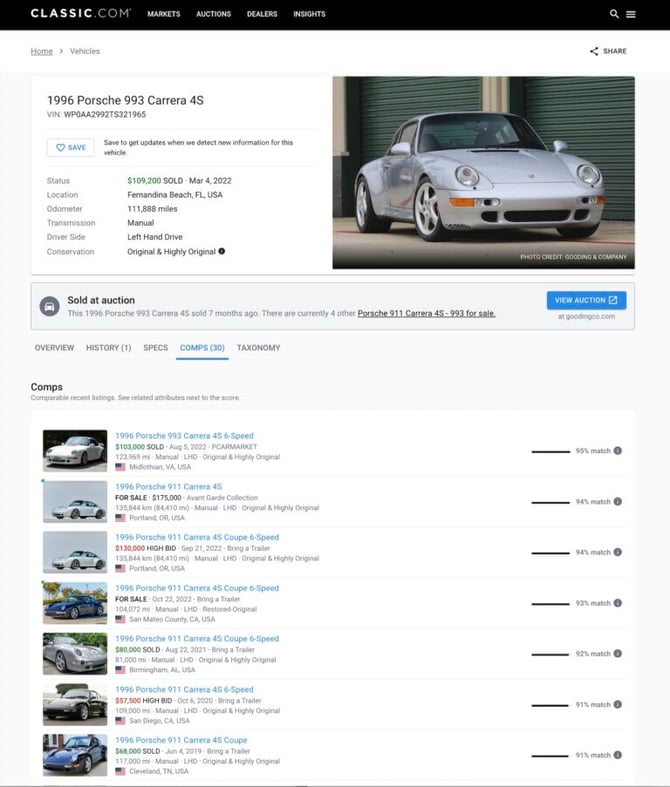
| As an example, let’s look at the list of Comps for this 993 Carrera 4S, which sold for $109,200 on March 4, 2022. In this particular example, in this screenshot, the system found 11 comps with a relevance score above 90%. This means that for the Value Drivers that we currently have for this model, the system found 11 listings that almost match exactly (>90%) – meaning that they are very strong Comps to evaluate the market value of this vehicle. The relevance or match score starts to decrease as the system finds vehicles with differences in the Value Drivers for this market, ie, less relevant comps.
|
|
To be clear, Comps on CLASSIC.COM should not be thought of as showing the exact price that someone would/should pay for a certain car. The goal is to give guidance by evaluating listings based on specific Value Drivers that can be assigned to each listing and compared against each other.
Currently, the Value Drivers we are using in Comps are:
- Taxonomy (Make, Model, Generation, etc)
- Attributes (Colors, Transmission Type, etc)
- Originality (Original, Restored, etc)
- Location (Country)
- Mileage (is the comp relevant to the target with respect to mileage)
- Recency (how recent is the comparable data point)
Future iterations of Comps will include other Value Drivers such as:
-
Condition (what is the comp’s condition relative to the target)
-
Precise Location (State, or City)
- Variable relevance scoring based on market-specific value drivers (ie matching numbers engine on Porsche 356’s, but not for 5th gen Toyota 4Runners)
As you can imagine, certain things matter more than others. For example, exterior color generally matters more than interior color – and that is weighed into our Comps algorithm. But it gets even more complicated: the transmission type in a Ferrari F355 is a huge determinant of value, but not so much if it’s a 2nd Generation Toyota 4Runner. Therefore, expect relevance scores to adjust over time as we refine the algorithm to take these market nuances into account.
We hope that you find Comps useful in researching your next purchase or sale of a classic, exotic, or specialty car. We will be constantly updating the algorithm in order to give you better insights, and we always look forward to your feedback. It’s what drives us. Send it to: pitcrew@classic.com